By Amanda Rose Newton
Planting a new tree can feel a little precarious in Central Florida. Between sandy soils, summer thunderstorms, tropical weather, and the possibility of hurricanes, it can be tempting to stake every young tree and tie it down as securely as possible.
However, not every newly planted tree needs to be staked. In some cases, unnecessary or improperly installed staking can actually cause more problems than it prevents.
The purpose of staking is to temporarily stabilize a tree while its roots become established in the surrounding soil. It should not prevent the tree from moving naturally, nor should it remain in place indefinitely.
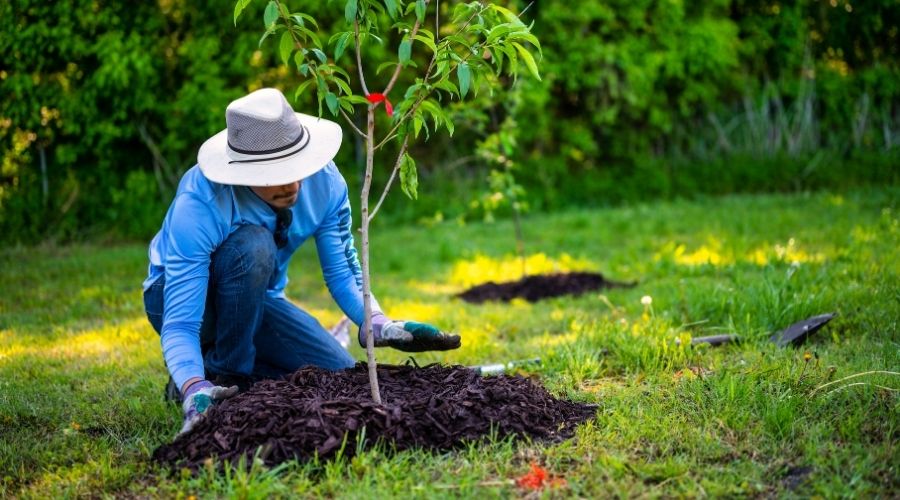
Does Every New Tree Need to Be Staked?
A newly planted tree that stands upright on its own and has a stable root ball generally does not need staking simply because it is young. This is especially true of smaller, healthy container-grown trees planted in an appropriate location.
Staking may be helpful when:
- The root ball rocks or shifts noticeably in the planting hole.
- The tree cannot remain upright on its own.
- The root system or root ball is relatively small compared with the canopy.
- The tree is planted in a particularly windy or exposed location.
- A recently planted tree has been shifted or tipped by severe weather.
- A field-grown tree has a loose or unstable root ball after planting.
In Central Florida, sandy soils can sometimes make newly planted trees more prone to movement. Still, staking should be based on the stability of the individual tree rather than automatically done to every tree that goes into the ground.
There is also no simple list of species that always need staking. A small, well-rooted live oak might need no support at all, while a larger tree of the same species with an unstable root ball might benefit from it. Tree size, root condition, canopy size, planting method, and site conditions matter more than the name on the plant tag.
A Little Movement Is Good
One of the most common misconceptions about staking is that a newly planted tree should not move at all.
The goal is to keep the root ball reasonably stable while allowing the trunk and canopy to move somewhat naturally. A tree that is held completely rigid is being supported more than necessary.
When installing stakes:
- Use only enough support to keep the root ball stable.
- Attach supports as low on the trunk as practical while still keeping the tree upright.
- Allow some movement of the trunk.
- Use wide, flexible straps made for supporting trees.
- Keep straps loose enough that they do not press tightly against the bark.
Natural movement helps a young tree develop the trunk and root strength it will eventually need to support itself.
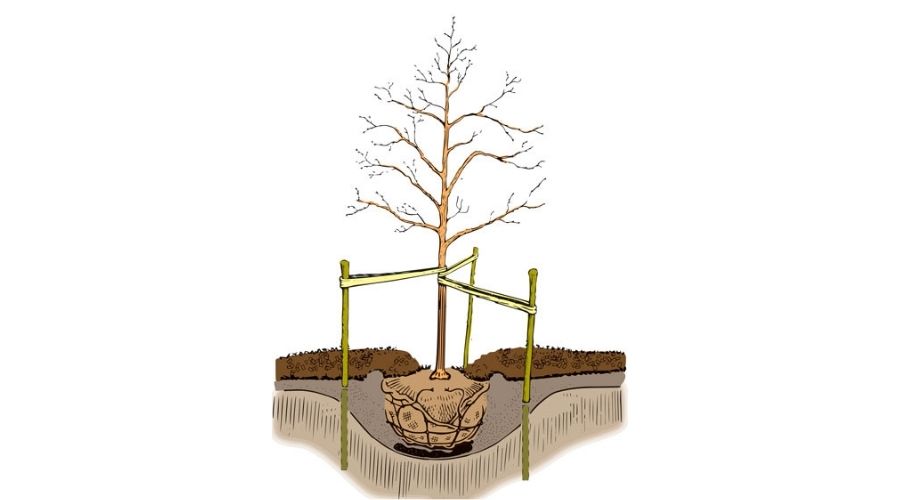
Common Ways People Damage Trees With Stakes
Staking can begin as an attempt to protect a tree and eventually become the thing damaging it. Many problems occur because a staking system is installed and then forgotten.
Some of the most common mistakes include:
- Using wire, rope, or thin cord directly against the trunk. These materials can cut into the bark as the tree grows and may eventually girdle the trunk.
- Tying straps too tightly. Even a wide tree strap can damage bark when it becomes tight.
- Immobilizing the tree. A tree does not need to be held completely rigid to establish successfully.
- Attaching ties too high. Supports generally need to stabilize the lower portion of the tree, not prevent the entire canopy from moving.
- Leaving the nursery stake attached. The narrow stake tied directly against a tree at the nursery is usually intended for production and transportation, not permanent landscape support.
- Forgetting to adjust the straps. A young tree can increase in trunk diameter surprisingly quickly.
- Leaving stakes in place for years. Stakes and straps are temporary equipment, not permanent landscape features.
- Using stakes to compensate for poor planting. Staking cannot correct a tree that was planted too deeply, has severe circling roots, or has other serious root problems.
Girdling damage is particularly easy to miss. A strap, wire, or tie may gradually become embedded in the expanding trunk. By the time the problem is obvious, it may already have damaged the tissues responsible for moving water and nutrients through the tree.
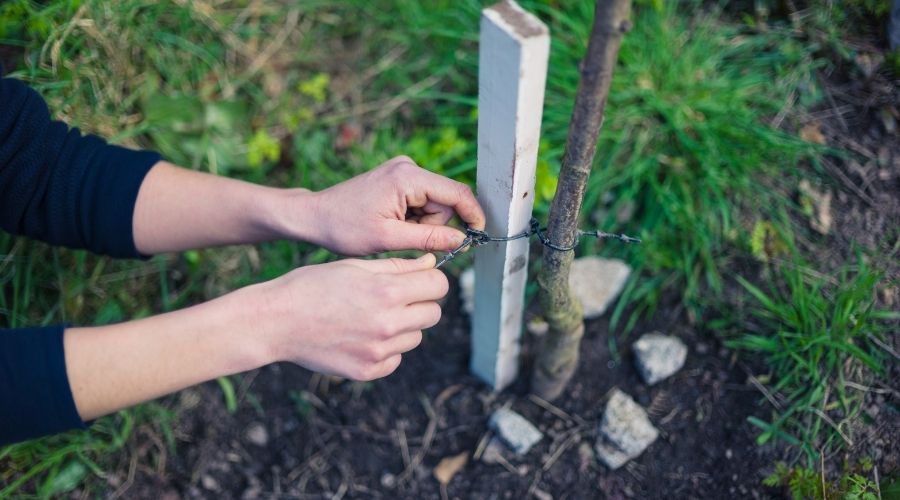
Don’t Forget the Nursery Stake
This deserves special attention because it is so commonly overlooked.
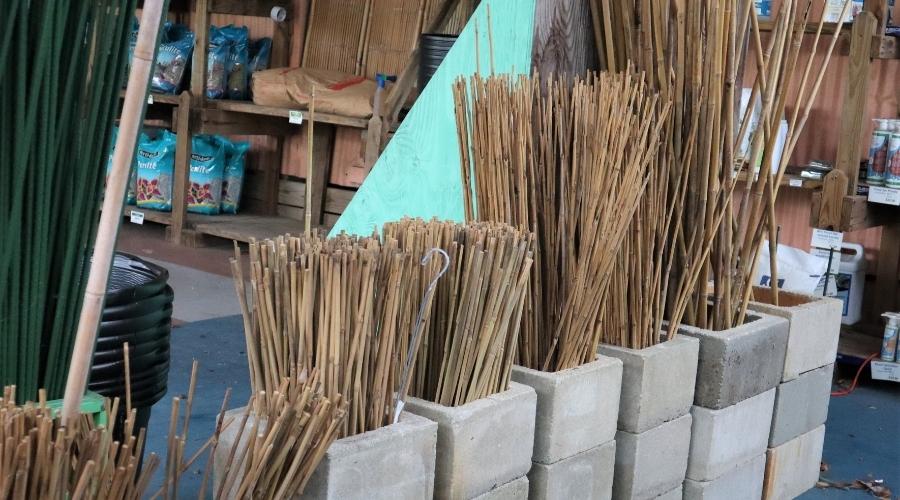
Many container-grown trees arrive with a narrow bamboo, fiberglass, metal, or wooden stake positioned immediately alongside the trunk. The trunk may be attached to it in several places with tape or plastic ties.
That stake helped produce a straight, marketable tree at the nursery. It does not necessarily mean the tree needs to remain attached to it after planting.
At planting time:
- Check for ties hidden among the foliage.
- Remove tight tape, plastic, wire, or other attachments from the trunk.
- Evaluate whether the tree can stand independently.
- If support is actually needed, install a landscape staking system that allows more natural trunk movement.
Leaving a production stake tightly attached to a rapidly growing tree is an easy way to end up with trunk damage later.
How Often Should Stakes and Straps Be Checked?
Staking should never be a “set it and forget it” part of planting a tree. Check the system regularly, particularly during periods of rapid growth and after severe weather.
When checking a staked tree, look for:
- Straps beginning to press into the bark.
- Indentations or abrasions where straps touch the trunk.
- Wire, rope, or ties becoming embedded in new growth.
- Loose stakes.
- Straps that have slipped out of position.
- Movement of the root ball in the soil.
- A tree that is leaning despite being staked.
- A tree that now stands securely without relying on the supports.
If a strap is becoming tight, do not wait until the scheduled removal date. Loosen, reposition, or remove it immediately.
Florida’s long growing season makes these inspections particularly important. Trees can put on considerable growth while gardeners who installed stakes months earlier may barely notice the gradual increase in trunk diameter.
When Is It Time to Remove the Stakes?
Stakes and straps should always be considered temporary.
Guidance from Florida Universities* generally recommends removing staking systems around one year after planting to reduce the risk of girdling and other damage. More rigid staking systems may need adjustment or removal sooner.
However, that does not mean every tree should remain staked for exactly one year.
Ask:
- Does the tree stand upright without support?
- Has the root ball become stable in the surrounding soil?
- Can the trunk move without the entire root ball shifting?
- Is the staking system still serving a useful purpose?
If the answers indicate that the tree is established and stable, the supports may have completed their job.
Likewise, if a tree remains extremely unstable after a year, simply leaving it staked indefinitely may not be the answer. Persistent instability can indicate a problem with the root system, planting depth, planting technique, or establishment.
What About Hurricanes?
Florida homeowners understandably worry about how newly planted trees will handle tropical storms and hurricanes. Temporary staking can be useful for stabilizing a newly planted tree while its roots establish, but leaving stakes attached permanently does not hurricane-proof a tree.
For long-term wind resistance, focus on:
- Choosing an appropriate tree for the location.
- Giving roots adequate room to develop.
- Planting at the correct depth.
- Correcting serious circling or defective roots at planting.
- Developing good branch structure through appropriate pruning.
- Keeping established trees healthy.
- Inspecting trees for structural problems before hurricane season.
After a major storm, check recently planted trees even if they are still standing. Saturated soil combined with strong winds can shift a root ball without completely toppling the tree.
Small, recently planted trees that have tipped may sometimes be straightened and temporarily supported while their roots reestablish. Large established trees that have fallen or suffered significant root damage are a different situation and may require evaluation by a qualified arborist.
Give the Tree Support, Then Let It Grow
The best staking system is ultimately one the tree no longer needs.
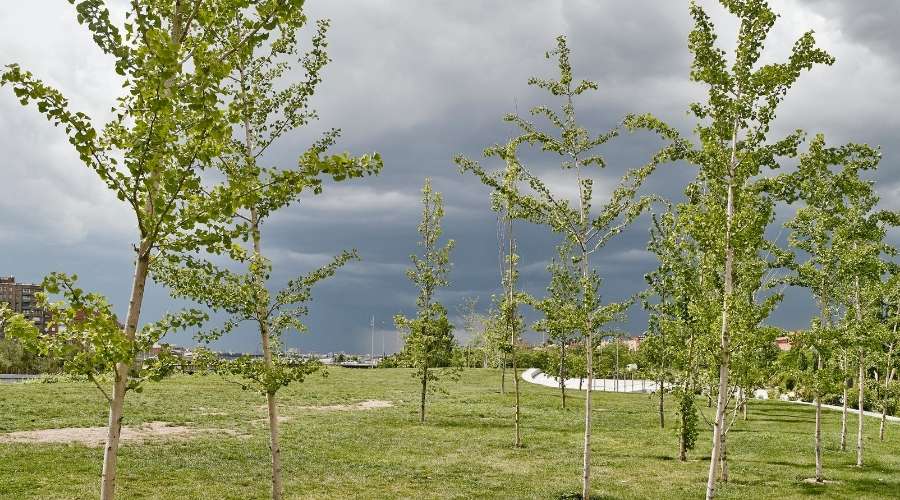
A newly planted tree does not automatically need stakes simply because it is young. When support is necessary, the goal is to stabilize the roots while still allowing some natural movement above ground.
Remember the basics:
- Stake only when necessary.
- Use wide, flexible straps.
- Allow the trunk some movement.
- Check straps regularly as the tree grows.
- Remove nursery stakes and tight production ties.
- Never allow straps or wire to become embedded in the trunk.
- Remove the staking system once the tree is stable.
A little temporary support can help a young tree get established, but eventually the roots and trunk need to take over. The goal is not to keep a tree tied up. It is to help it reach the point where it can stand securely on its own.
*(University of Florida Tree + Shrub Research https://hos.ifas.ufl.edu/woody/research.shtml)